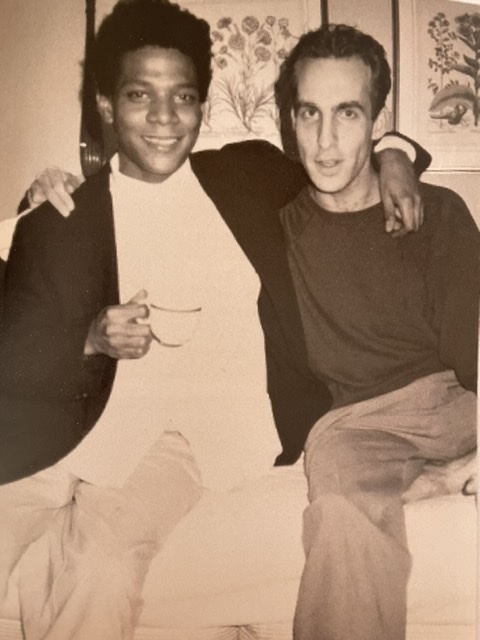
Photo above of Jean-Michel and John Lurie.
What makes a great artist part one; what is great art and who makes it?
I am reading John Lurie’s History of Bones and he is describing a dinner party with some of the New York heavyweights. John Lurie, for those new to the name, is an artist, musician and actor who found success acting in Jim Jarmusch’s early films, or maybe he made Jim more successful. He formed the Lounge Lizards in New York, made the incredible Fishing with John series and more recently Painting with John.
John Lurie is always someone I’ve resonated with; I’ve re-watched Jarmusch’s Stranger than Paradise heaps, am right now listening to Lurie’s music at random on Spotify, I love his paintings; everything John Lurie does I love. In this memoir John Lurie is describing a dinner party with Julian Schnabel, Andy Warhol, Jean-Michel and others, including the art dealer Bruno Bischofberger. He describes Warhol as cringe and condescending. And at the dinner party Lurie spirals into self-destruction:
“It was too much. My poverty was making me bitter, so I got drunk and went sour on the lot of them. What on earth made every napkin they drooled on valuable?” (252)
“I said too loudly, “How does it work? You drool on a napkin. Bruno decides that it is valuable. You sell it and then go out and buy this thousand dollar bottle of wine? I can appreciate that you guys are enjoying the fact that your work sells for a fortune, and for the most part I believe your work is good, but you must have some idea how many great artists there are taking quaters in tollbooths or living on the outskirts of Coney Island, who are as talented as you” (253)
For me, it’s this perspective that makes John Lurie a great artist. For fun I watch interviews with Adam Sandler, another great artist, who seems to share the same perspective. It’s the perspective, I think, that makes a great artist. It’s rooted, I think, in the idea that we are all artists but as time goes on in our life the playing field is thinned out by those who made it through luck, grit, privilege, and stupidity (or a mix of the lot). Great artists seem not to forget that everyone is an artist. It’s the main perspective of the great German artist Joseph Beuys.
Lurie continues, writing about the dinner party: “There was a hush. I had not actually offended anyone. They were unoffendable. I had only shown myself to be uncouth. I was out of the club” (253)
I’ve seen these clubs in my own walk of life; I’ve gone to art shows where the art is shit, like spat on napkins and all the people there are wannabe part of an exclusive club of artists, which is a different feeling, to me, than a more generative community of practice–there is something too cool about it, like I imagine it might have been at dinner for Lurie. It’s not that the art is bad, shit art is good art, in my opinion – it’s the vibe in the exclusive gallery that seems to purposefully forget that anyone could have made the shit art; if you’re there, in the room, never forget how lucky you are, but there is a forgetfulness present that Lurie describes. But probably it’s lucky for him that he was uncouth and got kicked out because he is still making brilliant art while those others are, for the most part, dead. And I don’t know if death makes a great artist? It might make great art but I am talking about the artist here. At least, to me, I get really excited by artists who live and keep making stuff till they are really old.
John Lurie has kept the magic thing alive (I think this is what makes great art); he has just shifted mediums when needed. Now, from what I see, he is dedicated to painting. He paints these really beautiful oil paintings that look like they must take ages to create, like dot paintings, and he usually finds some mythical animal out of the paint and brings it to life.
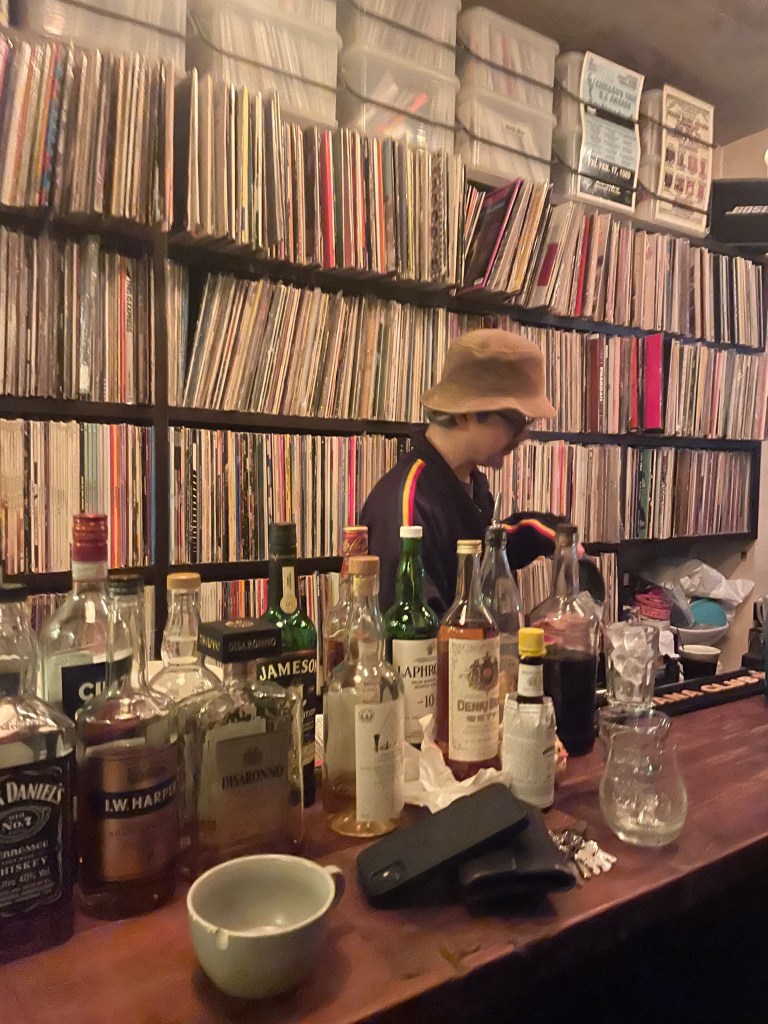
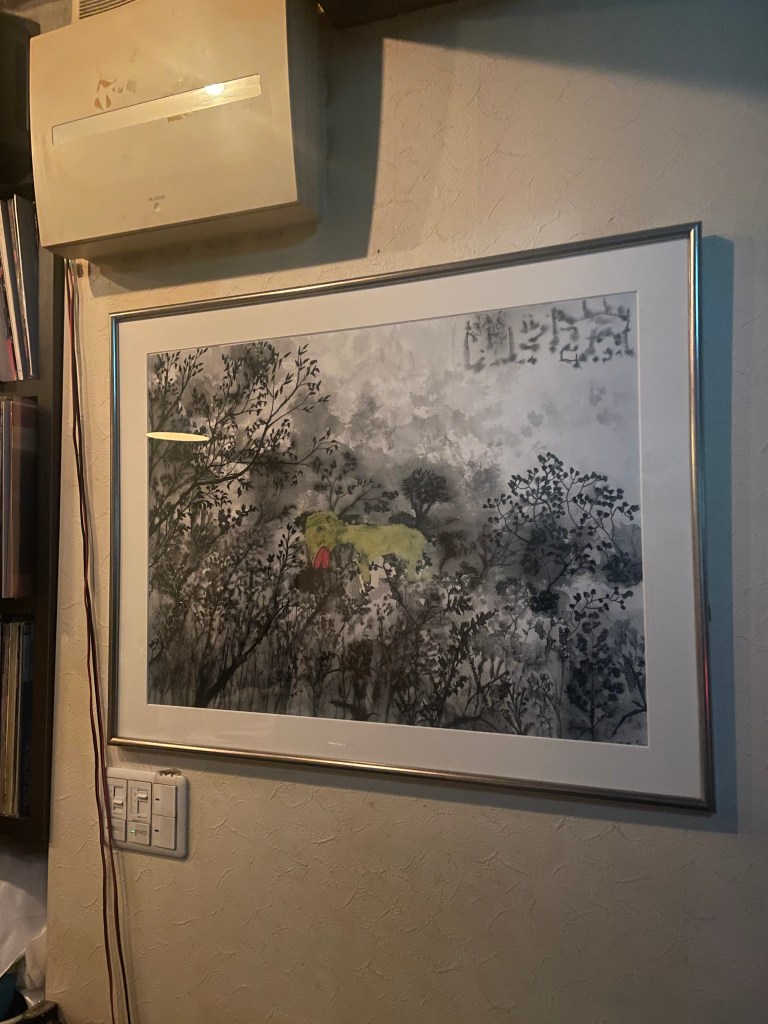
Funnily enough, I was in Japan earlier this year for my own painting show and I went into this bar that a friend recommended one night. It was classic; upstairs, like being inside someones disgusting lounge room, just shit everywhere but all the shit was records and music paraphernalia. Turns out this Japanese guy spent like twenty years working as a disc jockey in New York and on the wall, beside the bar, was this original framed John Lurie. I sat at that bar staring at that work. It was beautiful. Here are two photos I took at that bar, of the guy and Lurie’s work:
On describing some of the success Lurie had back in the day in New York he writes, “Life feels corrupt and hollow. And remarkably lonely”.
It’s not success that makes a great artist, i think we all know that. So, what is it? It is somehow about nurturing that magic thing, and being flexible with how it unravels, from you to the thing you do, to the world. It’s the kind of magic that’s inside everyone, the kind that John Lurie describes oozing out of Italian actor Roberto Benigni (who is also still alive and making great art). “Benigni is a ray of light. Hardly speaks any english but clearly has a remarkable mind. He is also a rascal and an irritant. A school where I am a founding member” (264).
So maybe it’s just about this light, this magic light, following it, caring for it–in the same way you walk with a tealight candle toward the oil burner on a windy day; that’s what makes a great artist, they are careful to not let the flame go out; they follow the flame in devotion and admiration. And, of course, they are very cheeky, which seems fundamental.
Oliver Shaw. Unedited rambling. Monday 26 Aug. 10:42 AM.

 Dr Oliver Shaw
Leave a comment